
Please note that the English text on this page is AI translated and may contain inaccuracies.
This article is reprinted with permission from an original manuscript contributed to the “New Year Special Feature: Industrial Utilization of Microalgae” in the January 2026 issue of Monthly BIOINDUSTRY, published by CMC Publishing Co., Ltd.
Kohei Sato / Senior BioEngineer
Bio-based raw materials, including those derived from microalgae, are increasingly called upon to replace fossil resources. Meeting market demand for widespread commercial adoption requires large-scale production. Furthermore, to establish a stable, commercially viable microalgae industry, it is essential to identify and develop diverse applications from a single feedstock. This article examines the construction of large-scale microalgae production facilities and the development of their applications.
1. Introduction
To advance the creation of photosynthesis-based industries utilizing microalgae, Chitose Laboratory Corp. (hereinafter, “CHITOSE”) leveraged a project supported by the New Energy and Industrial Technology Development Organization (NEDO) to launch operations at a microalgae production facility in 2023. Spanning a cultivation area of approximately 5 hectares (ha), it ranks among the world’s largest facilities employing flat-panel photobioreactors (FP-PBRs). In parallel with operating this facility, CHITOSE is currently working to construct a 100-hectare microalgae production facility based on the operational insights gained from the 5-hectare site.
At the same time, CHITOSE is actively developing diverse commercial applications utilizing microalgae. One such achievement is the development of 100% bio-based (70% microalgae-derived) polyethylene terephthalate (PET) resin made from p-xylene obtained through the catalytic cracking of botryococcene produced by Botryococcus braunii.
This article introduces CHITOSE’s initiatives toward building large-scale production facilities alongside its latest application development milestone: PET resin manufactured using microalgae-derived terephthalic acid.
2. The Need for Large-Scale Microalgae Production and Application Diversification
To reduce CO₂ emissions, there is growing demand to shift raw materials and fuels toward bio-based alternatives, drawing significant attention to microalgae. To be commercially viable as replacements for conventional fossil resources, microalgae must achieve biomass production volumes sufficient to meet market demand while absorbing CO₂ during cultivation. Moreover, just as crude oil yields a wide range of products—including fuels such as gasoline and heavy oil, as well as plastics and textiles—microalgae must be utilized across diverse applications to build a stable industry.
Many bio-based raw materials absorb CO₂ through photosynthesis, raising expectations that net CO₂ emissions across their entire lifecycle—from end-product use to disposal—can reach zero. In the aviation sector, for example, the International Civil Aviation Organization (ICAO) adopted an international goal to achieve net-zero carbon emissions for international aviation [1]. Replacing fossil resources with bio-based feedstocks to curb CO₂ emissions requires building industries rooted in photosynthesis.
To evaluate the scale of bio-based raw material production needed to sustain an industry, aviation fuel provides a clear benchmark. In Japan, the Basic Policy for Promoting Decarbonization in Aviation was formulated pursuant to Article 131-2-7 of the Civil Aeronautics Act. Under its core policy guidelines for government action, Japan set a target for domestic air carriers to replace 10% of their fuel consumption with Sustainable Aviation Fuel (SAF).
Let us examine the actual volume required to replace 10% of aviation fuel with SAF. In 2023, Japanese domestic routes operated 862,699 flights, and scheduled domestic commercial flights were refueled with approximately 4 million kiloliters (kL) of jet fuel [2]. As a concrete example of refueling volume, a 2023 flight plan for a Boeing 767 flying from Tokyo Haneda to Hakodate carried 22,600 lbs (10,251.2 kg) of fuel, with an estimated consumption of 11,800 lbs between Tokyo and Hakodate, including taxiing [3]. Replacing 10% of the fuel required for this single flight with SAF would require 1,180 lbs (approximately 535 kg) of SAF. Assuming Botryococcus braunii is cultivated to supply enough microalgae-derived SAF to replace 10% of the jet fuel used on Japanese domestic flights, CHITOSE estimates that more than approximately 9,200 ha of microalgae cultivation area would be needed. Even to supply just 10% of that SAF demand from microalgae, production capacity would need to be roughly 180 times the scale of CHITOSE’s current facility. Furthermore, the Ministry of Land, Infrastructure, Transport and Tourism (MLIT) projects Japan’s SAF demand in 2030—including refueling for international flights by Japanese airlines—at 880,000 kL, meaning actual demand is even greater [4].
While these figures might suggest scaling up production with an exclusive focus on SAF, market economies are not always stable. During the COVID-19 pandemic, when international travel restrictions were imposed, kerosene aviation fuel in the Singapore market—which had traded between USD 75 and USD 82 per barrel throughout 2019—plummeted to a low of USD 22.338 per barrel in April 2020. One key reason the crude oil industry survived such market shocks is that crude oil supports a broad portfolio of end uses.
To produce microalgae at large scale and deploy it commercially, the business model must satisfy economic viability. For instance, Chlamydomonas reinhardtii, a green microalga widely used as a model organism in both academic research and industry, comprises 47% protein, 25% lipids, and 20% carbohydrates [5]. If only the lipid fraction is commercialized, economic value is generated from just 25% of the biomass. However, if these components are fractionated so that the protein and carbohydrates are also utilized, 92% of the biomass generates economic value. Assuming a biomass production cost of approximately JPY 360 (EUR 2.01) per kilogram [6], utilizing only the lipids means the 250 g of lipids bears the entire JPY 360 cost, bringing the cost per kilogram of lipids to JPY 1,440. When economic value is also captured from the protein and carbohydrates, the cost allocated to the 250 g of lipids drops to JPY 90, or JPY 360 per kilogram—one-quarter of the lipid-only price. The same principle applies to other microalgae species: maximizing the utilization of every component within the biomass is essential for achieving economic viability.
Furthermore, when utilizing lipids extracted from microalgae, aromatic compounds cannot be used entirely as fuel because aviation fuel standards strictly limit allowable aromatic content [7]. Since aromatic compounds are widely used as feedstocks for plastics and other resins, broadening microalgae utilization into these material sectors is essential. Globally, 3.8 billion tons of plastic are produced [8]; meeting a portion of this demand with bio-based raw materials can significantly strengthen overall economic feasibility.
Establishing photosynthesis-based industries through microalgae therefore requires constructing large-scale, stable production facilities capable of meeting global demand for bio-based feedstocks. At the same time, it is vital to unlock the full potential of microalgae by developing diverse applications—much like fossil resource industries—so that microalgae utilization achieves lasting economic sustainability.
First, we introduce our initiatives for large-scale production.
3. Construction of Large-Scale Production Facilities
At the 5-hectare microalgae facility introduced earlier, CHITOSE is conducting demonstration trials across multiple microalgae species. Located in Sarawak, Malaysia—near the equator at 1° north latitude—the site benefits from stable year-round temperatures and an extremely low incidence of natural disasters such as typhoons. Although modest relative to total global demand for microalgae, this facility is the world’s largest FP-PBR microalgae production facility.
To demonstrate stable production and respond to growing demand, CHITOSE will construct a 100-hectare pilot-scale microalgae production facility in 2027, also adopting FP-PBR systems in Sarawak, Malaysia. To achieve both cost-effectiveness and high productivity, the facility is being engineered for efficient operation with automation integrated across every stage—from cultivation control to microalgae deployment, harvesting, extraction, and purification. Much like automotive manufacturing plants that rely on robotics to establish standardized, automated production workflows, this facility is being designed with industrial cost efficiency and energy conservation in mind.
For the 100-hectare facility currently under development, CHITOSE plans to visualize sensor data and equipment operating statuses—such as pump performance—and build an automated control architecture driven by this data. Managing constantly fluctuating outdoor conditions presents significant challenges. For an organization whose core expertise has historically centered on biology and biometrics, developing weather-resistant sensing equipment, designing extensive outdoor piping networks, and selecting optimal plant machinery represent major engineering hurdles. To address these challenges, CHITOSE is advancing design and engineering alongside partners experienced in building large-scale industrial and plant facilities under MATSURI, a cross-industry collaborative initiative dedicated to establishing photosynthesis-based industries. The MATSURI initiative brings together diverse companies spanning the entire supply chain from raw materials to finished products, with 117 organizations participating as of October 31, 2025.
4. Metrics in Large-Scale Production
When conducting commercial production using living organisms, precise process control is critical. In agriculture—which closely resembles 5-hectare and 100-hectare microalgae facilities in terms of outdoor cultivation and land scale—there has been a growing push for both labor savings and data-driven efficiency. Various technologies are deployed to achieve this, including visualizing crop growth via the Normalized Difference Vegetation Index (NDVI) derived from unmanned aerial vehicles (UAVs) or satellite imagery, and automating irrigation control based on sensor data. Similarly, in plant breeding—where parameters from numerous individual plants must be captured simultaneously—UAVs are used to collect wide-area phenotypic data, extract features, and combine them with genetic data to accelerate and streamline selection [9]. In data-driven agriculture and plant breeding, capturing detailed biological metrics alongside wide-area field management data makes sensing technology indispensable.
In fermentation production, an area in which CHITOSE has long been active, parameters such as temperature, pH, and feed rate are individually controlled to govern production. To achieve optimal outcomes, CHITOSE has applied machine learning and cultivation control to acquired parameters, including previously untapped sensing data [10]. In a representative joint research project with a client company, combining sensing, machine learning, and automated control doubled fermentation production output compared to the client’s previous best operating conditions. By integrating this expertise in fermentation sensing, machine learning, and automated control with microalgae cultivation technologies and operational know-how, CHITOSE aims to unlock greater biological potential, enhance productivity and cultivation stability, and increase the economic value of large-scale production. Such data-driven bioproduction control represents a major paradigm shift from conventional biomanufacturing and will be indispensable for future large-scale microalgae production.
UAVs have already been utilized for wide-area data acquisition and anomaly detection in infrastructure inspections, such as bridges and levees [11]. Because inspecting equipment conditions alone requires substantial labor in large-scale facilities, CHITOSE is deploying UAVs not only for sensing and cultivation control, but also for facility management. For cultivation monitoring, CHITOSE is adapting the Chitose-Multi Sensor (CMS)—previously utilized in fermentation production—for outdoor environments while upgrading and developing new sensor modules (Figure 1). The Chitose-Multi Sensor is a device and cloud-connected system that acquires multi-parameter sensor data in real time; based on its proven track record, CHITOSE decided to deploy it for large-scale microalgae production. Unlike sensors designed for fermentation tanks, new sensors tailored specifically to the geometry of FP-PBRs are being designed, developed, and rolled out.
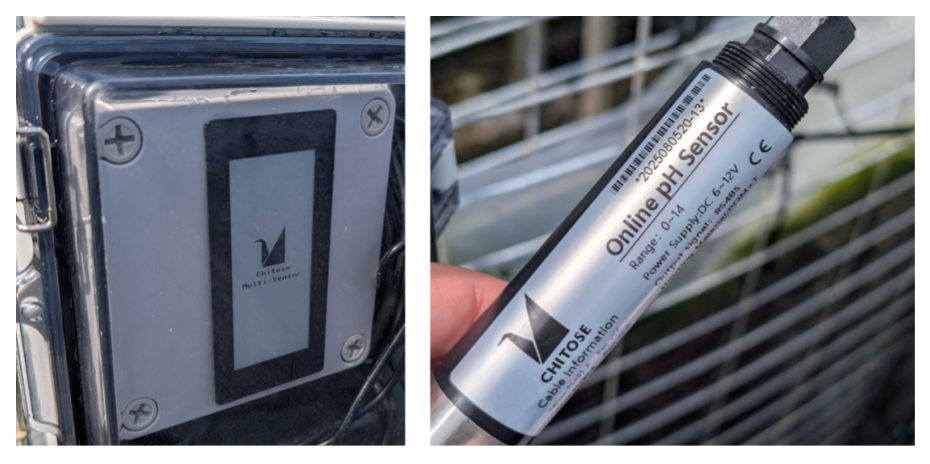
Equipping every single FP-PBR unit with sensors would result in prohibitively high capital costs. Instead, CHITOSE conducts targeted sensing on selected FP-PBR units, builds predictive models, and applies those models across overall production. By combining UAV-based data acquisition for thermal and environmental monitoring with optimal control of individual PBR plots, CHITOSE aims to ensure economic viability while improving cultivation stability and productivity.
Data collected from CMS units is transmitted in real time to the cloud for centralized management and production forecasting. Supporting this workflow across expansive outdoor facilities requires robust data-acquisition and network infrastructure. While wireless infrastructure such as Wi-Fi is a potential option, outdoor use of the 5.2 GHz Wi-Fi band is generally restricted due to frequency interference with radar systems, limiting its applicability. Moreover, the physical structure of FP-PBRs frequently attenuates radio signals, making stable communication difficult. Accordingly, at the 5-hectare FP-PBR demonstration facility currently in operation, CHITOSE uses a Low-Power Wide-Area (LPWA) network to gather data from field sensors. LPWA networks offer low power consumption, long-range communication (spanning several kilometers to tens of kilometers), and high-density device connectivity. Because LPWA operates on frequency bands whose radio waves diffract more easily around obstacles than Wi-Fi, it performs reliably over long distances and in environments prone to signal obstruction. Although its data transmission payload is smaller than that of Wi-Fi or 4G/5G standards, its low communication cost makes it versatile across a wide range of applications. Already gaining traction in agriculture and aquaculture, LPWA is expected to serve as a core component of network infrastructure for microalgae production.
The data gathered through this architecture enables real-time visualization of cultivation conditions and generates optimal control setpoints. Accessible remotely as production forecasting and quality control metrics, these datasets allow operators to issue timely instructions and build an infrastructure capable of stable supply. By combining cultivation optimization technologies cultivated in fermentation with advanced data transmission infrastructure and sensing hardware tailored to large-scale microalgae production, CHITOSE is establishing an engineering blueprint not only for the 100-hectare facility currently under construction, but also for future commercial-scale plants—enabling them to function as state-of-the-art microalgae production “factories.”
5. Diversifying Applications for Microalgae-Derived Biomass and Its Necessity: The Case of PET Resin
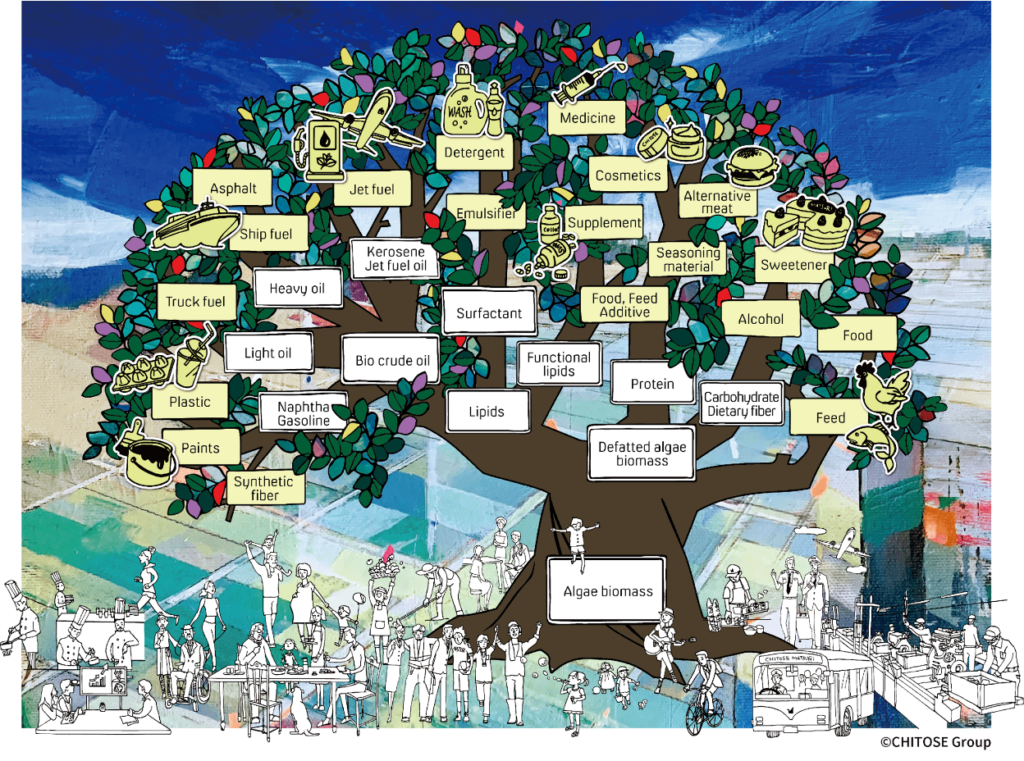
Scaling up microalgae production requires an equally thorough strategy for end-use applications. As noted earlier, microalgae contain a wide spectrum of biochemical components, and utilizing the entire biomass without waste is key to enhancing economic viability. Even within the lipid fraction alone, applications range from fuels to coatings and plastics. Developing these varied outlets prevents over-reliance on a single market target and fosters a stable, resilient industry akin to the fossil resource sector. Building photosynthesis-based industries demands converting every category of raw material into bio-based equivalents while maintaining commercial feasibility. CHITOSE is pursuing application development across multiple fronts, and as one recent breakthrough, successfully produced microalgae-derived polyethylene terephthalate (PET) resin. Below, we highlight this achievement as a case study in application development.
PET is a polymer represented by the formula (C10H8O4)n)n and synthesized via the condensation polymerization of terephthalic acid and ethylene glycol. Classified as a thermoplastic resin, its crystallinity imparts strong heat resistance, high transparency, mechanical strength, and excellent gas-barrier properties, making it ubiquitous across diverse applications, including beverage containers. Conventional manufacturing involves either esterification of terephthalic acid with ethylene glycol or transesterification of dimethyl terephthalate with ethylene glycol, followed by polycondensation of ethylene terephthalate.
Efforts to produce bio-based PET feedstocks date back to the late 2000s. In 2009, for example, The Coca-Cola Company launched PlantBottle, a 30% bio-based beverage bottle synthesized from bio-derived ethylene glycol and petroleum-derived terephthalic acid. While commercial production of bio-based ethylene glycol is already well established [12], synthesizing bio-based terephthalic acid has historically proven difficult. Its precursor, p-xylene, exhibits biological toxicity [13], and living organisms lack a natural biosynthetic pathway to produce it directly. Consequently, bio-based terephthalic acid has required multi-step chemical conversion processes starting from structurally related compounds.
One existing route to bio-based terephthalic acid uses sugars as a starting feedstock: isobutanol is produced via fermentation, converted into p-xylene through dehydration and dimerization processes, and then oxidized into terephthalic acid. Alternative synthetic routes starting from muconic acid or p-cymene (a precursor of limonene) have also been developed [14].
For CHITOSE’s PET resin prototype, hydrocarbon oil composed primarily of botryococcene (C34H58)), a hydrocarbon produced by Botryococcus braunii, was used as the starting material. Catalytic cracking of botryococcene yields a variety of aromatic compounds; alongside the target p-xylene, products include toluene, ethylbenzene, and trimethylbenzene, with p– and m-xylene reported to be generated at yields of around 12% [15]. Because these compounds are foundational building blocks in the petrochemical industry, this result indicates that a wide array of chemical products beyond PET can also be synthesized.
The ability to generate p-xylene directly through the cracking of botryococcene is highly advantageous for bio-based PET resin production. CHITOSE succeeded in producing high-purity, microalgae-derived p-xylene suitable for PET resin synthesis. Because this prototype required substantial quantities of biomass, it was made possible by Botryococcus braunii cultivated at CHITOSE’s large-scale production facility. Oxidizing the resulting p-xylene yields terephthalic acid for PET manufacturing. Because this pathway relies solely on catalytic cracking and high-purity refining—eliminating the dehydration and dimerization steps required in earlier bio-based routes—it closely mirrors conventional petrochemical terephthalic acid synthesis.
Using this microalgae-derived terephthalic acid together with bio-based ethylene glycol, CHITOSE produced prototype PET resin. Based on the molecular weight of the PET repeating unit, the material comprises approximately 70% microalgae-derived terephthalic acid and approximately 30% bio-based ethylene glycol, resulting in a 100% bio-based (approximately 70% microalgae-derived) PET resin. This material was exhibited at the Japan Pavilion at Expo 2025 Osaka, Kansai (Figure 2).
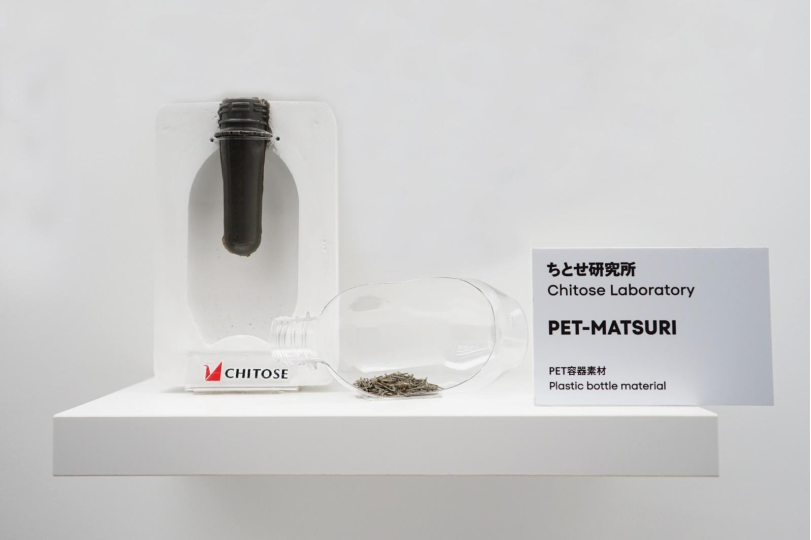
This milestone represents a foundational step toward expanding microalgae utilization, with further production cost reductions anticipated through measures such as increasing p-xylene yields. While several development hurdles remain—including improving chemical conversion yields, constructing dedicated processing plants, and lowering feedstock costs through large-scale cultivation—achieving these targets offers a clear path to an economically viable commercial product. Adding PET resin to the portfolio of microalgae applications broadens the commercial utility of microalgae-derived lipids. In particular, aromatic compounds such as p-xylene often must be removed when blending hydrocarbons into SAF; establishing dedicated material applications for these aromatics directly improves overall economic feasibility.
Many everyday products, including the PET resin featured here, are currently derived from fossil resources. Because fossil resource economics rely heavily on products manufactured from refining by-products alongside fuels, microalgae commercialization must similarly pursue a full-spectrum application strategy.
While this article focused on PET resin, CHITOSE and its co-development partners within the MATSURI initiative are actively advancing numerous other applications. By utilizing every component of microalgae without waste to bring a diverse portfolio of microalgae-derived products to market, CHITOSE aims to establish microalgae production and utilization as a stable, self-sustaining industry (Figure 3).
6. Summary
This article examined the dual imperatives of large-scale production and application diversification to meet market demand and replace fossil resources through microalgae utilization. CHITOSE is advancing R&D across both fronts simultaneously to drive the creation of photosynthesis-based industries. For large-scale production, CHITOSE is applying its biometrics and bioproduction expertise to engineer facilities capable of optimized microalgae cultivation. For application development, CHITOSE is pursuing full-biomass utilization—across lipids, proteins, and carbohydrates—to maximize economic viability and ensure stable industrial supply, exemplified by the world’s first microalgae-derived PET resin. To turn both wheels of large-scale production and application development, CHITOSE will continue tackling these challenges alongside its partners in the MATSURI initiative.
References
- Murata, K. et al., Energy & Fuels 28(11), 6999 (2014)
- Ministry of Land, Infrastructure, Transport and Tourism (MLIT), Air Transport Statistical Survey, e-Stat (2024)
- Japan Transport Safety Board (JTSB), Aircraft Serious Incident Investigation Report, AI2025-3-1-JA614J (2025)
- Civil Aviation Bureau, Ministry of Land, Infrastructure, Transport and Tourism (MLIT), Explanatory Materials for the 4th Public-Private Council for Promoting the Introduction of SAF (2024)
- Darwish, R. et al., Applied Sciences 10(19), 6736 (2020)
- Branco-Vieira, M. et al., Energy Reports 6, 325 (2020)
- Nippon Kaiji Kentei Kyokai (NKKK), Quality Standards and Testing of Sustainable Aviation Fuel (SAF) (2023)
- Takahara, A. et al., Chemistry and Education (Kagaku to Kyoiku) 70(10), 480 (2022)
- Sakurai, K. et al., The Plant Genome 15(4), e20244 (2022)
- Kawai, T., Seibutsu-kogaku Kaishi 103(5), 192 (2025)
- Watanabe, Y. et al., Advances in River Engineering 30, 589 (2024)
- Van Uytvanck, P. P. et al., ACS Sustainable Chemistry & Engineering 2(5), 1098 (2014)
- Rajan, S. T. et al., Journal of Clinical and Diagnostic Research 8(2), 271 (2014)
- Nakajima, H. et al., Polymers 9(10), 523 (2017)
- Kitazato, H. et al., Sekiyu Gakkaishi (Journal of the Japan Petroleum Institute) 32(1), 28 (1989)